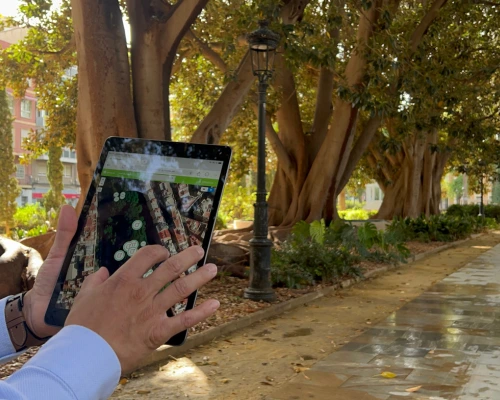
The Floridablanca Garden, one of Murcia’s most emblematic green spaces, has become an urban laboratory for advancing data-driven tree management. Promoted by the Murcia City Council in collaboration with Riversa and OdinS, the Garden Living Lab allows for testing IoT technologies in real-world conditions and generating knowledge about the behavior of its centuries-old ficus trees.
Challenge
The conservation of centuries-old trees presents a particularly complex challenge for park and garden teams. Variables such as water stress, soil conditions, and weather events can affect their evolution and stability, but their effects are not always easily detectable through conventional inspections.
The challenge was to obtain continuous and objective information on the behavior of the trees and their environment, generating historical data that allows for a better understanding of their dynamics and moving from reactive maintenance to a more preventive model.
Solution
OdinS, together with Riversa, has participated in the deployment of an IoT infrastructure capable of continuously monitoring both trees and soil conditions.
The solution combines data from various sensors with meteorological information to provide a more comprehensive view of the environment. This allows for the analysis of how trees respond to changes in water availability, irrigation, or environmental conditions, and provides municipal managers with supporting information to optimize irrigation, plan maintenance activities, and anticipate potential risks.
The Garden Living Lab also functions as a testing ground where new solutions can be validated before their application in other green spaces in the city.
Technology implemented
The project integrates different IoT technologies to build a joint view of the state of the trees and their environment:
- Dendrometers , which record small variations in the diameter of trunks and branches and allow the study of their growth and water dynamics.
- Wireless clinometers , designed to monitor changes in the inclination and position of branches.
- Soil sensors , which measure humidity, temperature, oxygen concentration and electrical conductivity.
- Meteorological information, used to contextualize and correlate the measurements obtained.
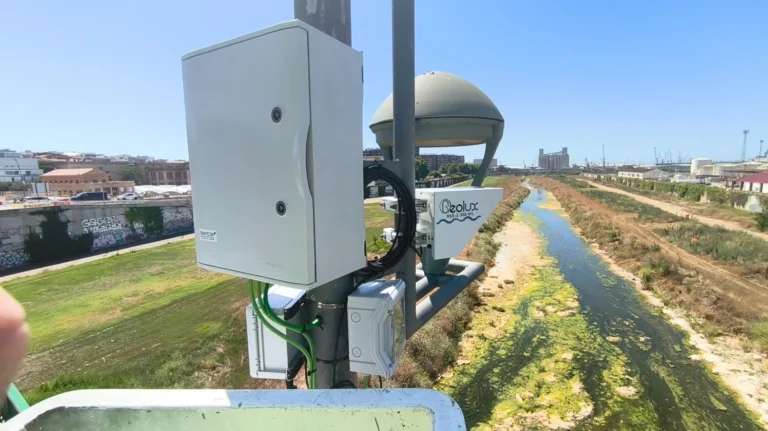
- LoRaWAN connectivity , which provides long-range, low-power wireless communications for devices distributed throughout the garden.
- Centralization of data , generating historical records that will serve as a basis for developing predictive models and moving towards a future digital twin of the tree population.
The result is an infrastructure that transforms data into a tool to better understand the behavior of urban trees, optimize their conservation, and move towards safer, more efficient, and sustainable management of green spaces.