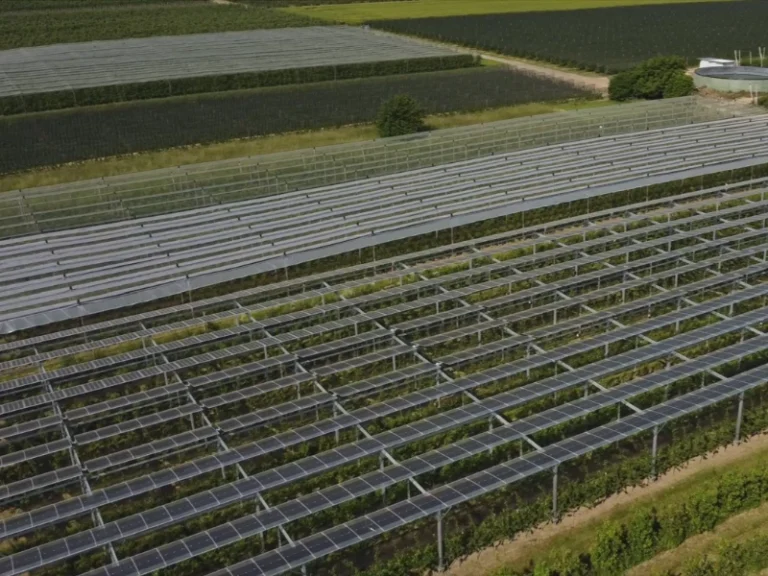
Agrivoltaics is one of the most interesting responses emerging to an increasingly evident challenge: how to take advantage of the hours of sunlight and produce more solar energy without compromising the agricultural use of the land.
Traditionally, the installation of large photovoltaic plants has meant occupying land that, in many cases, was agriculturally productive. This has generated a growing conflict between the need to advance the energy transition and the preservation of agricultural activity . In this context, agrivoltaics proposes a change of approach: instead of competing for land, it proposes sharing it.
How does agrivoltaics work?
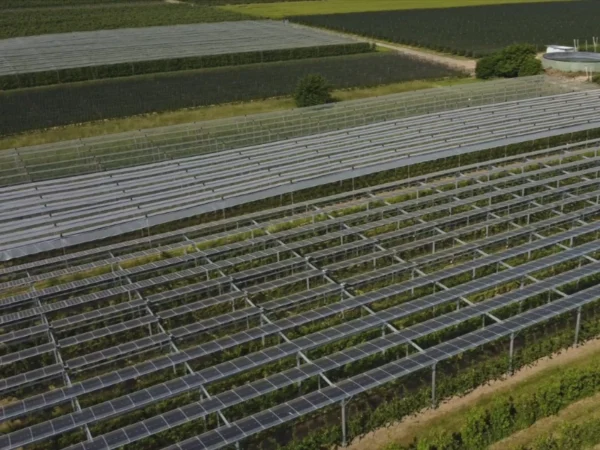
Agrivoltaic systems integrate crops and photovoltaic generation on the same land using structures designed to allow both activities to coexist. It’s not simply a matter of placing solar panels on farmland, but rather designing the system to ensure genuine interaction between the two elements. The height of the structures, the spacing between rows, and the use of solar trackers are key factors in enabling crop development while simultaneously maintaining efficient energy production.
The interest in these types of solutions is not accidental. On the one hand, there is increasing pressure on land use, especially in regions where agriculture plays a significant role. On the other hand, climate change is forcing a rethinking of agricultural production models, with problems such as water scarcity, rising temperatures, and soil degradation. In this scenario, agrivoltaics not only allows for the continued agricultural use of land, but also introduces conditions that, in certain cases, can be beneficial for crops.
The microclimate: one of the key factors in agrivoltaics
However, this coexistence is not without its complexities. One of the most important aspects of agrivoltaics is monitoring the specific microclimate generated beneath the solar panels. The radiation reaching the crop is lower and more diffuse, temperatures tend to be milder, and soil moisture can be retained for longer. These conditions significantly alter crop behavior, moving away from the typical open-field pattern and, in some respects, closer to what occurs in a greenhouse.
Agronomic challenges of crops grown under solar panels
This new environment necessitates a complete rethinking of agronomic management. Irrigation strategies , for example, can no longer be based on standard criteria but must be adapted to the actual soil and environmental conditions beneath the panels. Similarly, crop selection becomes crucial, as not all species respond equally to partial shade. Some may even benefit from this environment (less direct sunlight, milder temperatures, etc.), while others may experience reduced yields if not managed correctly.
The design of the agrivoltaic installation
Adding to this complexity is the design of the photovoltaic installation itself. Elements such as panel density, orientation, and the type of solar tracker directly influence the amount of light reaching the crop and, therefore, its development. This makes each agrivoltaic project virtually unique, requiring a balance between energy optimization and agricultural viability.
View this post on Instagram
Monitoring, key in agrivoltaics
At this point, technology plays a crucial role. The key to a functioning agrivoltaic system lies in understanding what is happening in real time and being able to act accordingly. To achieve this, it is necessary to continuously monitor variables such as:
- Solar radiation (both above and below the panels),
- Temperature,
- Air humidity ,
- Soil condition , including its water content or water potential.
This information allows us to understand how the crop responds to the conditions generated by the photovoltaic installation.
Key variables for optimizing agricultural performance
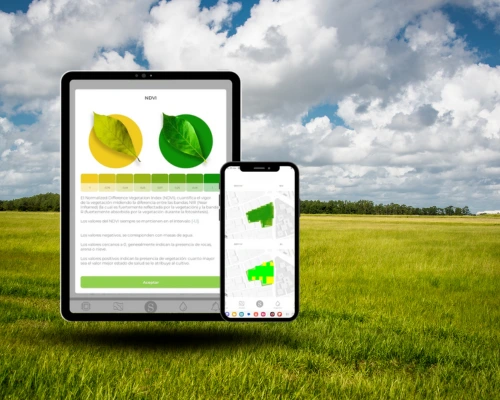
But measurement isn’t enough. The real advantage emerges when this data is used to act on the system. The ability to automatically adjust irrigation based on the actual soil condition, anticipate water stress, or adapt cultivation strategies to microclimatic conditions is what transforms an agrivoltaic installation into an efficient and profitable system. Furthermore, when this data is combined with the plant’s energy information, it opens the door to more advanced optimizations, where agricultural and energy performance can be analyzed together. You can learn more about crop monitoring in our smart farming solution, Ingrovia .
Innovation and the future of agrivoltaics
Despite its potential, agrivoltaics remains a developing field. Numerous studies and pilot projects are underway to determine which configurations are most efficient, which crops are best suited, and how different designs influence the balance between agricultural and energy production. New avenues are also being explored, such as the use of artificial intelligence and digital models to predict system behavior and facilitate decision-making. One example is IMIDA (Murcian Institute of Agricultural and Environmental Research and Development), which has an ongoing agrivoltaics project aimed at identifying the most appropriate agrivoltaic systems for various scenarios within the agricultural context of the Region of Murcia.
A new way to make use of the land
In short, agrivoltaics represents a natural evolution in how we understand land use. In contrast to a model where energy and agriculture compete, it proposes an integrated approach in which both activities can reinforce each other. However, its success depends on the ability to manage the complexity it introduces, combining agronomic knowledge, technical design, and advanced monitoring and control tools.
From this perspective, the development of technological solutions capable of providing visibility and control over these systems will be key to their consolidation. Agrivoltaics is not just a trend, but a real opportunity to move towards a more efficient, sustainable model adapted to the challenges of the future. If you want to know more about how we can help you with your agrivoltaics project, contact us . We offer free consultations!