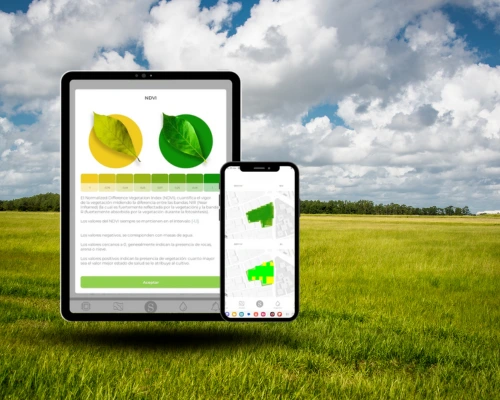
Two crops can grow under the same conditions of temperature, radiation, and water availability and still respond very differently. One of the keys lies in their photosynthetic metabolism. Understanding the differences between C3, C4, and CAM plants helps us better understand how they use water, how they react to heat, and how to interpret the data we now obtain through sensors and precision agriculture systems.
C3, C4 and CAM plants: three different strategies for capturing and fixing CO₂
All plants need to capture carbon dioxide (CO₂) to perform photosynthesis, but not all of them do so using exactly the same strategy.
Based on the mechanism they use to capture and fix CO₂, we can primarily refer to C3, C4, and CAM plants . This physiological classification has important implications for how each species responds to factors such as temperature, solar radiation, ambient humidity, and water availability.
And this has a direct application in agriculture.
When we measure what happens in a plot of land using sensors, a weather station, or an IoT system, we obtain information about the environment surrounding the crop. However, to convert that data into agronomic decisions, we also need to understand how the plant responds to those conditions.
That’s where knowing whether we’re working with a C3, C4, or CAM crop starts to become especially important.
What are C3 plants?
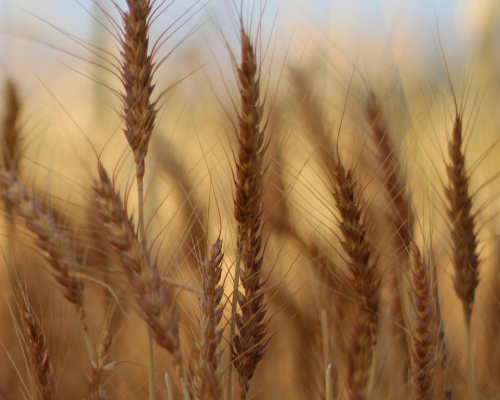
C3 plants constitute the largest group and include many of the main agricultural crops.
Some examples are:
- Wheat.
- Rice.
- Barley.
- Soy.
- Potato.
- Tomato.
- Vine.
- Citrus fruits.
They are called C3 because the first stable compound generated during CO₂ fixation contains three carbon atoms.
How do C3 plants perform photosynthesis?
During the day, C3 plants open their stomata to allow the entry of CO₂ necessary to perform photosynthesis.
The problem is that stomata are not solely a gateway for CO₂. While they remain open, water is also lost to the atmosphere through transpiration.
This exchange creates a constant balance between two needs: capturing enough CO₂ to maintain photosynthetic activity and avoiding excessive water loss.
When the temperature rises and the relative humidity of the air decreases, the evaporative demand of the atmosphere increases. In response to this, the plant can partially reduce its stomatal opening to limit water loss.
But that response has a consequence: when the stomata close, the entry of CO₂ also decreases .
Temperature and photorespiration in C3 plants
In addition to this effect, there is another important phenomenon: photorespiration .
When temperatures rise, photorespiration can become more important in C3 plants and reduce their photosynthetic efficiency.
Therefore, a combination of high temperatures, high atmospheric demand, and low water availability can especially affect this type of plant.
This does not mean that all C3 crops respond in exactly the same way. There are differences between species, varieties, phenological stages, and growing conditions. However, understanding their metabolism helps us better understand the response we observe in the field.
What are C4 plants?
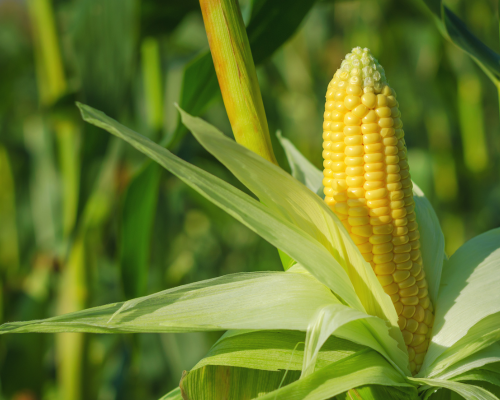
C4 plants use a different strategy to fix CO₂.
Among the C4 crops we find:
- Corn.
- Sorghum.
- Sugarcane.
- Darling.
These plants have a mechanism capable of concentrating CO₂ around the enzyme responsible for its fixation during photosynthesis.
Thanks to this adaptation, photorespiration is considerably reduced.
Why do C4 plants thrive in high temperatures?
The reduction of photorespiration allows C4 plants to generally maintain high photosynthetic efficiency under conditions characterized by:
- High temperatures.
- High solar radiation.
- Significant atmospheric demand.
- Limited water availability.
Furthermore, they can maintain high photosynthetic activity with a relatively smaller stomatal opening than many C3 species, which improves their water use efficiency.
This is one of the reasons why crops like corn or sorghum show good adaptation to warm environments.
However, it is important to avoid too hasty an interpretation here.
A more water-efficient C4 plant is not a plant that doesn’t need water.
Talking about greater efficiency in water use does not necessarily mean that a C4 crop has a reduced water demand.
Corn is a good example.
It can use water physiologically efficiently while also exhibiting considerable water demand throughout its life cycle. Furthermore, certain phenological periods are particularly sensitive to water deficit.
Flowering is one of them.
Therefore, classifying a crop as C4 does not mean it can withstand any situation of lack of irrigation. Physiology helps interpret its behavior, but it must always be considered in relation to the crop’s condition and the actual conditions of the field.
What are CAM plants?
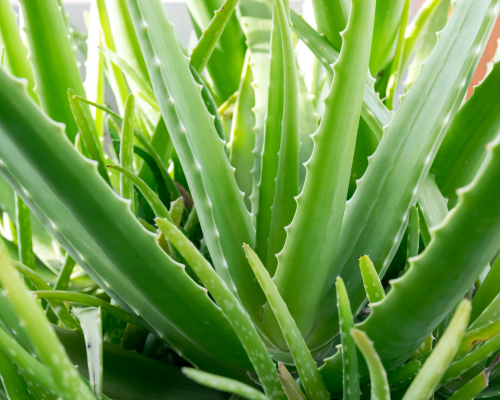
CAM plants have developed an even more specialized strategy to reduce water loss.
Among them we find:
- Pineapple.
- Agave.
- Aloe vera.
- Numerous species of cactus.
Their main difference from C3 and C4 plants is related to the time when they mainly perform gas exchange.
Why do CAM plants open their stomata at night?
While C3 and C4 plants mainly perform gas exchange during the day, CAM plants mostly open their stomata at night.
The reason is closely related to water conservation.
At night, the temperature is usually lower and the relative humidity is higher. Under these conditions, water loss associated with gas exchange can be significantly reduced.
The plant uses this period to capture CO₂ and store it temporarily in the form of organic acids.
During the day it can keep its stomata mostly closed and use the CO₂ captured during the night to continue photosynthesis.
This time separation between CO₂ capture and utilization allows CAM plants to achieve very high water use efficiency.
Differences between C3, C4 and CAM plants
Although all three groups perform photosynthesis, their strategies have important differences.
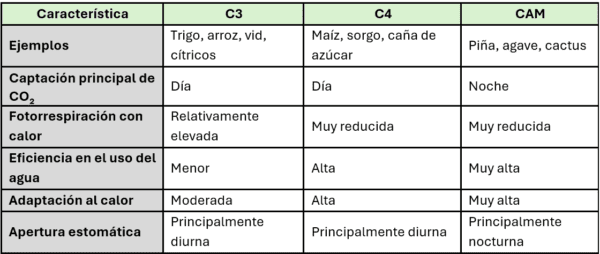
This comparison allows us to understand something fundamental: two crops exposed to exactly the same environment do not necessarily experience the same level of stress or respond in the same way.
And that is especially relevant when we start working with data from precision agriculture.
Why is it important to know if a crop is C3, C4, or CAM?
In a farm we can measure more and more variables.
For example:
- Soil moisture.
- Soil temperature.
- Electrical conductivity.
- Ambient temperature.
- Relative humidity.
- Solar radiation.
- Precipitation.
- Wind speed.
Furthermore, based on different meteorological variables we can work with indicators such as reference evapotranspiration (ET₀) or vapor pressure deficit (VPD).
All this information provides a much more detailed view of what is happening on the plot.
But there is a fundamental issue: having more data does not automatically guarantee making better decisions.
For the data to be truly useful, it must be interpreted taking into account how the crop works.
VPD, temperature and radiation: the environment is the same, the plant’s response is not always
The vapor pressure deficit or VPD is especially interesting because it allows us to approximate the evaporative demand that the atmosphere exerts on the plant.
When the VPD increases, the atmosphere has a greater capacity to demand water.
However, the same VPD value does not necessarily imply the same response in all crops.
A C3 plant and a C4 plant subjected to a similar combination of temperature, radiation, and atmospheric demand can regulate their stomata and maintain their photosynthetic activity differently.
Other factors will also play a role, such as:
- The availability of water in the soil.
- Root development.
- The phenological state.
- Variety.
- The prior conditions of cultivation.
Therefore, the value of an isolated variable is much smaller than that of its joint interpretation.
Precision agriculture and IoT: moving from measuring the plot to understanding what is happening
This is where IoT technology applied to agriculture becomes especially interesting.
A network of sensors can continuously record soil and environmental variables. A data logger can collect this data, send it to a platform, and allow users to monitor its evolution without having to travel to the plot repeatedly.
The important leap is not only in digitizing the measurements, but in relating different variables to obtain agronomic context.
For example, let’s imagine that a sensor located 20 centimeters away detects a reduction in soil moisture.
That reading alone does not tell us the whole story.
To interpret it correctly, we could ask ourselves:
- What VPD was recorded during those hours?
- What was the temperature and radiation level?
- What phenological stage is the crop in?
- How deep are they exploring the roots?
- How long has it been since the last watering?
- What is happening with other sensors installed at different depths?
It is precisely this approach that allows the development of precision agriculture based on data and not just on isolated values.
IoT solutions like Ingrovia allow for the integration of crop, soil, and climate monitoring with irrigation management within a single ecosystem. The platform can receive data collected in the field via devices such as the IPex12 , which functions as an irrigation controller and data logger, connecting sensors and control elements and transmitting information using technologies like GPRS or NB-IoT.
Thus, the data is no longer scattered across different readings and can be analyzed together using historical data, graphs, alerts, and rules of action.
But technology does not replace agronomic knowledge. It complements it.
Knowing whether we are dealing with a C3, C4 or CAM plant provides an additional layer to interpret why the crop may be responding in a certain way to the conditions being recorded by the sensors.
Does a reduction in soil moisture mean that the plant has used up all that water?
Not necessarily.
This is a good example of why sensor readings must be done with context.
If we observe that soil moisture decreases over several hours, it would be overly simplistic to attribute all that variation directly to root absorption.
To understand what is happening, it is helpful to consider simultaneously:
- Atmospheric demand.
- The temperature.
- The VPD.
- The depth of the measurement.
- The distribution of the root system.
- The phenological state.
- The physiology of the crop.
It is also particularly useful to observe the information in the form of time series, rather than analyzing only a single point value.
The patterns allow us to see how the soil responds after irrigation, how long it takes for the wetting front to advance, or at what times certain variations occur.
The better we understand these patterns, the more useful sensor technology becomes.
Do C3, C4, and CAM plants need to be watered at different times?
Not necessarily.
An overly simplistic interpretation could lead us to establish rules such as:
“C3 plants should be watered in the morning, C4 plants in the afternoon, and CAM plants at night.”
But plant physiology doesn’t work that way.
Whether a plant is C3, C4, or CAM helps us understand how it manages gas exchange and how it responds to certain environmental conditions, but it does not automatically determine when we should activate irrigation.
The most appropriate time depends on a much wider set of variables.
What factors should we consider when deciding when and how much to water?
Inter alia:
- The amount of water available in the soil.
- The soil’s retention capacity.
- Root depth.
- The irrigation system used.
- Evapotranspiration.
- The VPD.
- The temperature.
- The phenological state.
- Water quality.
- The production strategy.
It is also important to differentiate between two processes that are sometimes confused: the opening of the stomata and the absorption of water by the roots.
They are related, but they are not equivalent.
For example, the fact that a CAM plant mostly opens its stomata at night does not automatically mean that it should be watered at night.
The decision must respond to the actual conditions of the soil-plant-atmosphere system and the crop management objectives.
From scheduled irrigation to information-based irrigation
Traditionally, many irrigation decisions have been based on schedules, pre-established frequencies, or the experience accumulated by the farmer.
That experience remains extremely valuable, but technology allows it to be supplemented with information that was previously difficult to obtain continuously.
A precision agriculture system can help us to know:
- When does humidity begin to decrease at a certain depth?
- How the soil profile responds after each irrigation.
- If the water actually reaches the root zone.
- When do the conditions of greatest atmospheric demand occur?
- How the variables evolve over several days or weeks.
- If there is an issue with the irrigation system.
- How different sectors of a farm behave.
Furthermore, by connecting monitoring with controllers and solenoid valves, IoT allows you to go a step further and act on the installation, not just observe it.
It is possible to schedule irrigation, control sectors remotely, or establish rules based on certain conditions.
The key remains the same: automation isn’t simply about executing a command when a sensor reaches a certain number. A good strategy needs to integrate the data with knowledge of the crop.
C3, C4 and CAM within an increasingly data-driven agriculture
Precision agriculture is greatly increasing our ability to observe what is happening in the field.
Today we can know with high resolution when the humidity has dropped to 20 centimeters deep, how the wetting front has moved after irrigation, or at what time the highest VPD of the day was reached.
The next step is to make all that information meaningful.
And for that we need to understand the plant.
Knowing whether a species uses a C3, C4, or CAM metabolism does not, by itself, determine how we should manage the crop, but it does help to explain why some crops respond better than others to high temperatures, why some exhibit greater water use efficiency, or why the same environment can generate different levels of stress.
Precision agriculture faces one of its greatest challenges precisely there: connecting what we measure in the soil and in the atmosphere with what is actually happening in the crop.
Measuring water is important; understanding how the plant uses it is also important.
C3, C4, and CAM plants represent three different physiological strategies to solve the same challenge: capturing CO₂, performing photosynthesis, and simultaneously managing water loss.
C3 plants are the most common group, but they can lose efficiency when high temperatures, high atmospheric demand, and water limitations coincide. C4 plants have mechanisms that considerably reduce photorespiration, allowing them to function efficiently in warm environments with high radiation. CAM plants have taken water conservation even further by primarily shifting CO₂ uptake to nighttime.
These differences are important, but in agriculture they should be interpreted as one more piece within a complex system.
We cannot decide on irrigation solely because a crop is C3, C4, or CAM. Nor can we correctly interpret a sensor reading by looking only at the last recorded value.
The real usefulness appears when we combine plant physiology, agronomic knowledge, and data from the soil and the atmosphere.
Because to better manage water, it is not enough to know how much is available.
We also need to understand how the plant is able to use it.