Knowing how to choose an irrigation system for a soccer field goes far beyond comparing equipment or budgets. The choice should be based on technical criteria that truly affect the system’s performance: distribution uniformity, scheduling, maintenance, climate, surface type, and the actual use of the land.
On a sports field, irrigation is more than just a maintenance aid. It’s an infrastructure that directly impacts turf quality, playing safety, water consumption, and the facility’s operating costs. Therefore, the key lies not only in deciding which system to install, but in choosing the solution that maintains a stable and uniform surface with minimal water waste.
Why choosing an irrigation system is a strategic decision
From the perspective of a club, a sports complex, or a management entity, the right decision isn’t simply “which system to install,” but rather which solution will maintain a stable and uniform surface, with minimal water consumption and more controllable operation over time. This is where a rigorous technical approach makes the difference between a system that simply irrigates and one that truly manages the field.
In this scenario, smart and automatic irrigation systems, such as WiKeeper, have become a fundamental tool to improve the efficiency and effectiveness of the installation, while contributing to maintaining a healthy lawn in optimal condition.
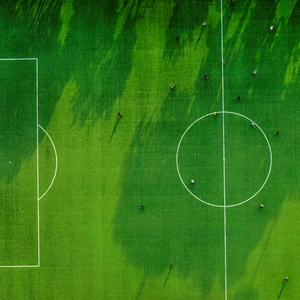
A football field doesn’t just need water, it needs hydraulic engineering.
One of the most frequent mistakes when planning the irrigation of a football field is to approach it solely in terms of the volume applied. In reality, the agronomic and functional performance of the turf depends much more on the quality of the application than on the quantity of water alone. Irrigation frequency, uniformity of distribution, depth of wetting, and the system’s ability to adapt to the actual soil and climate conditions are far more decisive variables than the mere amount of water supplied. The principle of deep and infrequent irrigation remains a widely accepted practice in professional turf management, as it promotes deeper root systems, improves water use efficiency, and reduces the incidence of problems associated with shallow and repetitive irrigation.
Furthermore, a properly adjusted irrigation strategy helps maintain a more uniform surface, with better coverage and less variability in parameters that affect playing quality, such as firmness and the ground’s response to intensive use. For a club or management entity, this means that the irrigation system impacts not only the visual appearance of the field, but also its functional stability, maintenance, and performance during play.
What should a club evaluate when choosing an irrigation system for a football pitch?
As organizations like FIFA point out, the choice of system should be based on a prior technical analysis, since not all fields require the same solution, nor should all projects be resolved with the same hydraulic architecture. In the specific case of football, the choice of an irrigation system must take into account variables such as the type of surface, the climate, the intensity of use, the soil composition, the level of automation, and the available budget.
1. Surface type
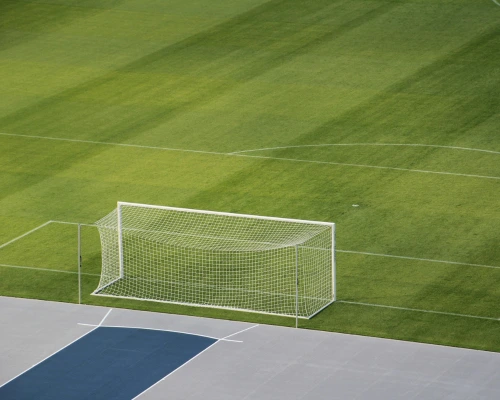
The first point is the type of field. In natural grass , irrigation serves to maintain the plant in suitable conditions, promote its recovery, and support healthy and uniform growth. In artificial turf , water does not play a role in growth, but it can be used to reduce surface temperature, facilitate cleaning, or improve certain usage conditions. WiKeeper is designed specifically for different types of sports fields, including football, rugby, polo, and tennis, and for both natural and artificial surfaces.
It is also worth noting that in professional football, hybrid systems , which combine natural grass with synthetic fibers, are becoming increasingly common in intensive or multi-purpose facilities, as they offer greater resistance and consistency than conventional natural grass in certain contexts.
2. Intensity of use
The frequency of field use completely alters the system’s performance requirements. A primary field with daily activity and competitions requires very different performance than a secondary or occasional-use facility. The greater the usage pressure, the more crucial it becomes to have a solution capable of maintaining uniformity, responding quickly to operational adjustments, and minimizing deviations between sectors.
3. Climate and water behavior of the site
The local climate directly influences how irrigation should be designed and programmed. In hot, dry areas or those with high evaporation , water management requires greater precision to avoid stress on natural turf or overheating on synthetic surfaces. In more humid environments or those with frequent rainfall , the priority often shifts to preventing excess water and ensuring effective drainage.
And even more importantly, FIFA emphasizes that not only does the general climate of the area matter, but also the microclimate generated by the stadium itself. The roof configuration, the height of the stands, or the lack of natural ventilation can alter light, shade, and air movement over the pitch, directly affecting the performance of the grass. Furthermore, in the current design of fields and stadiums, it is becoming increasingly common to increase the planned drainage capacity by 30% to 40% to better respond to episodes of heavy rainfall and scenarios associated with climate change.
4. Budget and efficiency objectives
Budget matters, but it shouldn’t be the only factor. Systems with greater automation, programmable control, and integration capabilities typically require a larger initial investment, but they also allow for more precise operation, reduced waste, and lower maintenance and operating costs in the medium term. In facilities with more limited resources, manual or portable alternatives can be considered, but these usually offer less precision and greater reliance on human intervention.
What types of irrigation systems exist for a football field?
At a technical level, in sports fields there are usually three main approaches.
Surface sprinkler irrigation
It remains the most widespread solution for natural turf. It allows for covering large areas, facilitates visual inspection of its operation, and offers a high degree of flexibility in zoning and programming. When well-designed, it is a highly versatile system for sports facilities where quick adjustment and operational visibility remain important.
Subsurface irrigation
This option delivers water directly to the root zone via buried lines. Its main advantage is the potential for water efficiency by reducing losses due to evaporation or runoff, although it requires a larger initial investment and more demanding engineering for design, installation, and maintenance. It makes sense in projects where water efficiency is a priority and there is technical capacity to operate the solution rigorously.
Manual or portable solutions
They still exist in small, temporary, or budget-constrained settings, but their operation is often less consistent. In a professional or semi-professional environment, these solutions tend to increase manual labor, introduce more variability between sectors, and hinder precise water management.
Uniformity of distribution is one of the most important criteria
In many projects, the first consideration is the number of emitters, the brand, or the budget. However, one of the parameters with the greatest practical impact is distribution uniformity . A field can receive water and still be poorly irrigated if there are excessive differences between areas. When this happens, the system ends up compensating for local deficits with longer general irrigation times, which increases consumption and worsens operational efficiency.
Therefore, when choosing an irrigation system for a football field, it is advisable to prioritize solutions that allow for consistent coverage, logical sectorization, and sufficiently fine operation to adapt the application to the reality of the terrain.
Choosing well also means being able to program well.
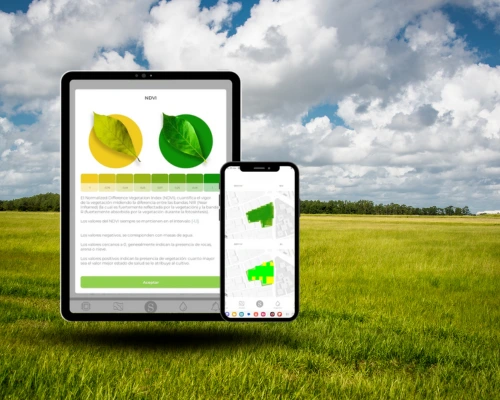
A well-designed irrigation system doesn’t end with the water network or the installation of emitters. Its true value emerges when it allows for precise field management, adapting to surface conditions and simplifying daily operations. This is where WiKeeper comes in: a smart irrigation solution for sports fields that adapts to both natural and artificial turf and allows users to move from a fixed schedule to data-driven management.
Applied to a football pitch, this means the facility gains flexibility and is no longer solely dependent on rigid schedules. WiKeeper Cloud allows you to configure zones, customize the pitch, create bespoke irrigation programs, and monitor the facility from a centralized, clear, and intuitive environment. Furthermore, it can be integrated with existing systems, making it easy to modernize management without completely rebuilding the infrastructure.
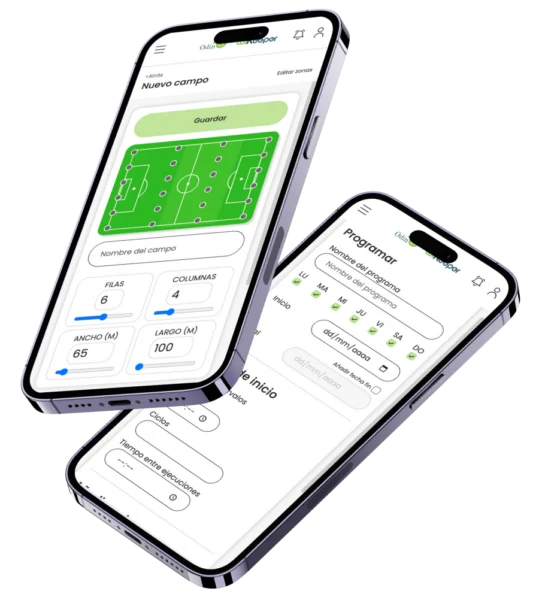
One of its strengths is the combination of soil and climate data to better refine decision-making and move towards smarter irrigation. The IPex30G professional controller incorporates analog and digital inputs, as well as an SDI-12 port, allowing for fine-tuning of programming based on actual field conditions.
In addition, there’s a key operational advantage: the IPex30 can work independently or connected to the platform and features manual selectors , making it easy to directly control the system when immediate local control is needed. Overall, WiKeeper not only automates irrigation but also helps manage it with greater technical expertise, efficiency, and ease of use.
In this context, smart irrigation for a football field allows the operation to be adjusted to real soil and climate data , reducing dependence on fixed schedules.
Maintenance remains crucial
In practice, many systems lose performance not due to their initial design, but because of the gradual degradation of components and adjustments. Small leaks, pressure variations, poorly regulated emitters, or unbalanced sectors can affect both water consumption and irrigation quality. Therefore, when choosing a system, it’s important to also consider its ease of inspection, adjustment, and maintenance. A good design shouldn’t just work on commissioning day; it should remain operational, serviceable, and reliable several years later.
So, how do you choose an irrigation system for a football field?
The best choice isn’t a one-size-fits-all solution or solely focused on the initial investment. The right system will be the one that fits the technical and operational realities of the field, ensures sufficient uniformity, allows for programming based on real variables, can be maintained smoothly, and responds to the level of use of the facility.
For a football club, this translates into a very clear conclusion: the best solution is not necessarily the cheapest or the most sophisticated on paper, but the one that allows for a safe, uniform and competitive surface with the least possible waste of water and with greater technical control over the operation.
If the goal is to evolve from manual or rigid management towards a more precise, automated operation supported by soil and climate data, WiKeeper fits as a particularly robust solution for sports facilities.
Frequently asked questions about irrigation in soccer fields
What is the best irrigation system for a soccer field?
There is no single solution that works for all situations. The best option depends on the type of surface, the climate, the intensity of use, the budget, the level of automation, and the water efficiency goals.
Which system is most commonly used on natural grass fields?
Surface sprinkler irrigation remains the most widespread solution, as it allows for the coverage of large areas, facilitates visual inspection, and offers good scheduling flexibility.
Does it make sense to water an artificial turf field?
Yes. Although it is not irrigated to keep the surface alive, water can be used to reduce the temperature, improve certain conditions of use, and facilitate cleaning tasks.
Why is uniformity of distribution so important?
Because poor uniformity creates areas with water deficits and others with excess water. This forces over-irrigation to compensate, increasing consumption and harming both efficiency and the quality of the surface.
What are the advantages of a smart irrigation system?
It allows you to adjust the programming to real soil and weather data, reduce waste, improve the technical control of the installation and simplify daily operation.