In this article, we explore how digital organic agriculture is becoming a key player in the future of farming. Throughout the text, we analyze the challenges and opportunities of the transition to more sustainable agricultural models, how digitalization and IoT solutions help reduce inputs and optimize resources, and why regenerative agriculture and technological innovation form an essential partnership for ensuring soil health, food security, and farm profitability.
Why digital organic farming and why now
Organic farming is not a fad, but an urgent response to environmental, social, and economic challenges. It allows us to produce quality food while caring for water, soil, and biodiversity, without being a luxury or a whim: it is the only way to guarantee health, food security, and a habitable planet for all. And, together with innovation and digitalization, it represents an opportunity to transform European agriculture into a fairer, more resilient, and more sustainable model.
This month we celebrate EU Organic Farming Day , proclaimed by the European Parliament, the Council and the European Commission, which designates September 23 as an annual date to “celebrate organic production, a sustainable type of farming in harmony with nature, biodiversity and animal welfare” ( ec.europa.eu).). It is a remarkable opportunity to reflect on how digitalization amplifies the impact of organic farming, reinforcing its key role in the transition to sustainable food systems.
Organic and regenerative agriculture is booming, and as a result, more and more producers are choosing to leave conventional farming behind and embrace a model based on soil health, reduced inputs, and long-term sustainability. But this path is not without its challenges: maintaining profitability, ensuring certification, and managing resources efficiently.
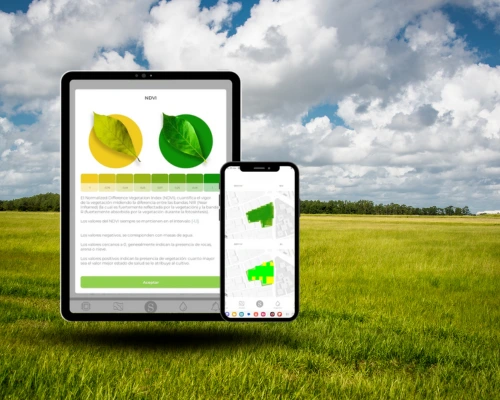
This is where digitalization and IoT (Internet of Things) solutions become key allies. Sensors, data platforms, and decision support systems help farmers better understand their farms , save resources, and transparently demonstrate that they produce sustainably.
The conversion process supported by digitization
Initial diagnosis
Before taking the leap, digitalization allows for soil mapping, identification of variability within the plot, and analysis of irrigation and fertilization history . Thanks to this, farmers can understand the soil’s characteristics, which areas retain water best, and where crop stress is concentrated. With this objective foundation, transition planning will be more confident and will prioritize the areas requiring the most attention. It’s like having a “medical check-up” for the farm, enabling informed decision-making.
Reduction of chemical inputs
With moisture and nutrient sensors, irrigation and fertilization are no longer based on a schedule but rather on actual need, indicating when and how much water is required. This reduces waste and prevents fertility loss.
Furthermore, predictive pest models allow applications to be made only when the risk is high , facilitating the gradual abandonment of chemical treatments and their replacement with products authorized for organic use.
Fertility restoration
The foundation of regenerative agriculture is keeping the soil alive. Here, digitalization helps manage cover crops using soil moisture and temperature data , monitor compost quality, and balance nutrient inputs and outputs. All of this accelerates the recovery of soil life without jeopardizing yields.
Resource optimization
In extensive farming, every drop of water counts. Smart irrigation systems, combined with sensors and decision platforms, allow for water savings of between 20 and 40% and reductions of up to 30% in organic fertilizers by applying them at the precise moment. Furthermore, weather stations and leaf wetness sensors make it possible to predict the risk of diseases such as downy mildew.
This way, action can be taken only when necessary and with treatments compatible with the organic certification. The result is economic efficiency and environmental sustainability.
Certification and added value
Digital field notebooks automatically record irrigation, applications, and other tasks, simplifying paperwork and providing the traceability required for organic certification. Beyond simply complying with regulations, digitalization opens the door to smart labeling that shows consumers the product’s journey, reinforcing its market value.
Results that are already tangible with digital organic farming
Experience in different crops and regions confirms that digitalization is not only compatible with organic farming, but enhances it:
- Water : average reductions of 20–40% in consumption.
- Fertilizers : up to 30% less liquid organic inputs thanks to more precise control.
- Treatments : fewer applications, especially of copper and sulfur, by using data-driven risk models.
- Energy and costs : less pumping, fewer passes and a smaller carbon footprint.
Regenerative and digital agriculture: one path
Digitalization also aligns with regenerative principles. Monitoring soil moisture and plant health helps protect the microbiology, prevent leaching, and reduce water stress. In systems with cover crops, sensors allow for decisions about when to mow without compromising the main crop.
Organic farming doesn’t mean going back to the past, but rather combining the best of tradition with the best of innovation. Sensors, data platforms, and decision support systems are tools that help protect water, soil, and biodiversity, while keeping the farm productive and competitive.
Digitalization doesn’t replace the farmer’s knowledge, but rather enhances it. Because in the end, the one who knows the land best is the one who works it.
The transition to digital organic farming is a challenge, but also a great opportunity. Thanks to IoT solutions in the field , farmers can save water and nutrients, regenerate soil fertility, easily meet organic certification requirements, and offer high-value, traceable products. EU Organic Farming Day underscores the importance of highlighting these efforts and the essential role of digitalization in this transformation towards a more sustainable and resilient European countryside.