In a city, not all risks are obvious. A large urban tree, located in a high-traffic area and with an unknown structural condition, can become a serious problem, for example, during a severe storm.
Today, IoT technology allows us to anticipate that danger. In this article, we’ll tell you how wirelessly connected smart sensors help protect these urban giants, detecting water stress and structural failures in time that could affect everyone’s safety.
Importance of urban tree management
Urban trees perform vital functions such as temperature regulation, CO₂ capture, and improved social well-being. However, trees in poor condition can pose a danger to citizens. Environmental monitoring technology has taken a leap forward with the use of smart sensors, enabling constant surveillance that minimizes risks. This not only reduces accidents but also optimizes the allocation of municipal resources.
What is an IoT monitoring system for urban trees?
An IoT-enabled tree monitoring system collects environmental and structural data using connected devices, transmits it wirelessly, and centralizes it for analysis. This method provides key information without continuous human intervention, reduces costs, and improves accident prevention capabilities.
- Changes in the diameter of the trunk or branches.
- Structural inclination.
- Soil moisture, temperature, and oxygen.
Furthermore, thanks to its integration with smart platforms, the data can be turned into predictive alerts, generating action plans before an actual incident occurs.
Main IoT sensors for urban trees
Dendrometers
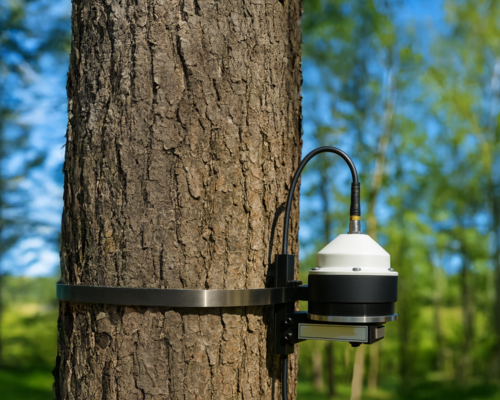
They allow for measuring changes in trunk diameter, which can indicate water stress in trees or structural deterioration. This is key for the early detection of water stress in urban trees.
Learn more about connected dendrometry in OdinS
Benefits:
- Early detection of water stress in trees.
- Planning preventive pruning.
- Risk reduction in pedestrian areas.
Tilt sensors
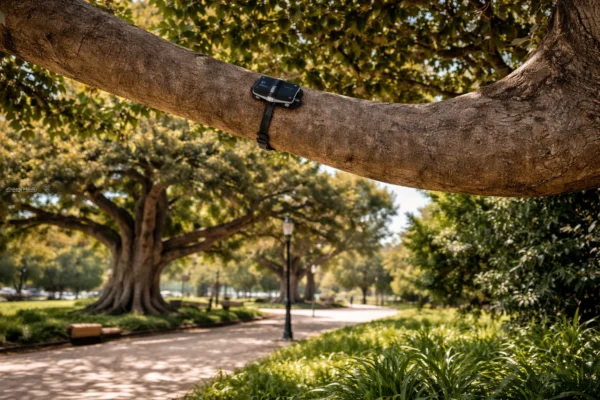
They detect dangerous angular deviations in branches or trunks, indicating a risk of falling. It is a critical tool for IoT-enabled tree monitoring in areas with high pedestrian traffic.
- Real-time alert about dangerous movements.
- Activation of preventive closures.
- Intervention before collapse.
Soil sensors
They measure humidity, temperature, and oxygen in the root zone, helping to identify water stress conditions in trees from the root.
- They prevent loss of anchorage.
- They improve irrigation planning.
- They increase the tree’s resilience.
LoRaWAN Communications
LoRaWAN technology allows multiple sensors distributed throughout a park or urban area to be connected with low power consumption and long range. Thanks to this technology, IoT-based tree monitoring becomes scalable and efficient.
Intelligent management platform
The sensor data is centralized in a control panel that allows:
- Visualization of key metrics in real time.
- Automatic alerts for anomalies.
- Maintenance prioritization according to risk level.
Citizen security in the center
Protecting the integrity of urban trees also means protecting citizens. Thanks to IoT-enabled tree monitoring and the early detection of water stress in trees, action can be taken before unexpected branch or tree falls, especially in school zones, parks, and busy avenues.
Practical example
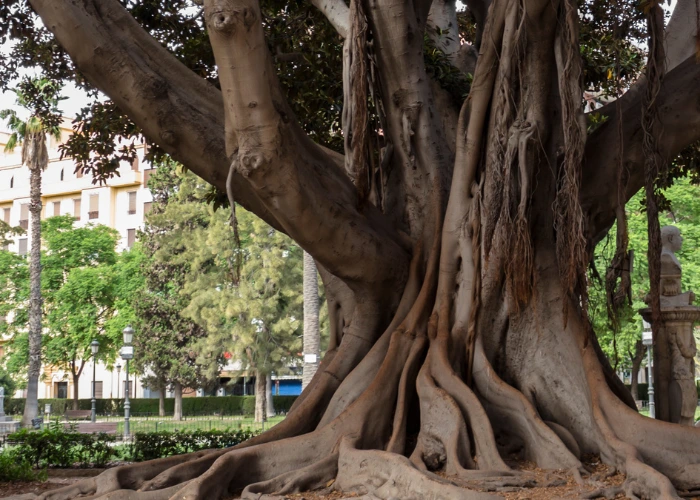
An urban park with ficus trees receives high pedestrian traffic. IoT sensors connected to a LoRaWAN network are installed. A tilt alert triggers preventative pruning. Result: no damage or accidents. This strategy not only prevented an incident but also built trust within the community and served as a model to replicate in other green spaces.
Conclusión
IoT technology applied to urban trees, along with IoT-enabled tree monitoring and early detection of water stress, represents a crucial step towards safer, more sustainable, and more resilient cities. It is an investment with a direct impact on public safety, plant health, and the operational efficiency of local governments.
At OdinS, we have over 10 years of experience in IoT solutions for Smart Cities. Want to know what we can do for your city? Contact us today; our team of experts will advise you to find a solution tailored to your challenges.
FAQs
How does IoT-enabled tree monitoring help prevent falls?
It detects structural changes or tilting before collapses occur.
Which sensors are key for urban trees?
Dendrometers, tilt sensors and soil sensors (humidity, temperature and oxygen).
Why use LoRaWAN?
Greater range, lower energy consumption, and connection of multiple sensors with less infrastructure.